

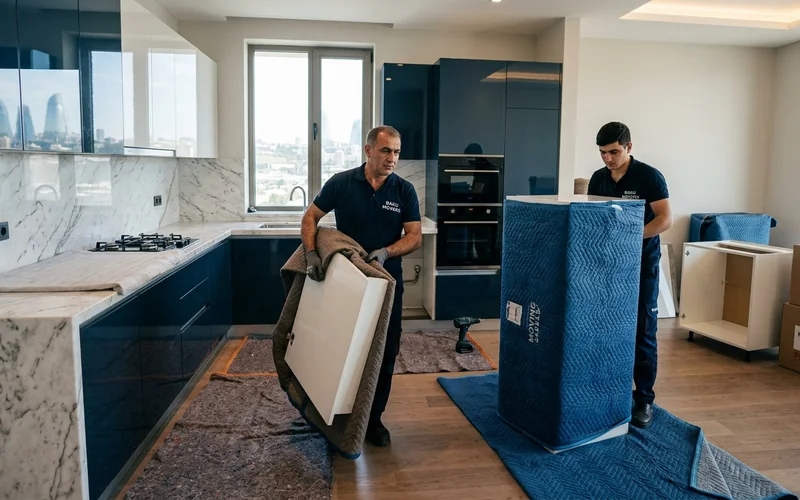
Kitchen furniture moving in Baku: disassembly and safe setup
Kitchen furniture moving is universally recognized as one of the most demanding, delicate, and technically complex phases of any residential relocation. Unlike freestanding bedroom or living room furniture, a modular kitchen setup consists of interconnected wall-mounted cabinets, sturdy base units, sensitive plumbing and gas lines, and expansive, heavy countertops. Navigating relocations in Baku introduces distinct architectural realities, ranging from vintage Soviet-era apartment buildings (Khrushchev and Leningrad layouts) with narrow stairs and no elevators, to modern high-rise towers requiring meticulous navigation through freight elevators. Without precise preparation, delicate acrylic facades, glossy MDF finishes, and custom-cut stone surfaces face significant risks of chipping, scratching, or structural fracturing. Achieving a seamless move demands systematic dismantling, specialized shock-absorbing packing, and professional reassembly tailored to the new floor plan.
Kitchen furniture moving preparation and initial safety measures
Disconnecting plumbing and integrated home appliances
Before loosening any cabinet screws, all connected utility systems must be safely isolated. The primary water shutoff valves and gas supply lines must be completely closed, and kitchen electrical circuits should be disconnected. Once the sink, faucet, and built-in dishwasher are uninstalled, residual water inside drain hoses must be thoroughly drained to prevent water damage to particleboard structures. Built-in ovens, extraction hoods, and induction cooktops should be carefully extracted, with their power cables neatly coiled and taped to their housings.
Emptying cabinet interiors and removing fragile items
All shelves, dinnerware sets, cookware, and pantry goods must be completely removed prior to dismantling. Moving cabinets while loaded puts immense torsional stress on cam locks and structural joints, creating severe safety hazards for movers. Glassware and porcelain plates must be cushioned in heavy-duty corrugated cartons, while removable tempered glass shelves must be taken out and wrapped separately.
Systematic labeling and hardware cataloging
Before separating interconnected cabinets, draft a clear layout diagram and assign numerical codes to each module. For instance, label base modules from left to right as B1, B2, and B3, and upper hanging cabinets as U1, U2, and U3. Marking these codes on protective wrap or rear panels eliminates confusion during reinstallation and accelerates the reassembly process.
Essential packing materials and surface protection techniques
High-grade protective packaging serves as the indispensable barrier against transport damage. Painted facades, delicate veneers, and acrylic finishes are highly prone to surface friction. To ensure complete protection during transit, professional movers rely on the following specialized supplies:
- Air-cushioned bubble wrap: Absorbs mechanical shocks and shields lacquered cabinet doors from impacts.
- Heavy-duty stretch film: Prevents dust and moisture infiltration while securing protective layers together.
- Reinforced cardboard corner protectors: Shields fragile cabinet corners and edge bandings from structural denting.
- Quilted moving blankets: Isolates adjacent cabinets inside the transport truck to prevent friction scuffs.
- Zip-lock hardware bags: Keeps hinges, shelf pins, and mounting screws organized without misplacement.
Protecting quartz, marble, and laminate countertops
The countertop represents both the most valuable and structurally vulnerable element of the entire kitchen. While postformed laminate surfaces can suffer edge chips, natural marble, granite, and engineered quartz worktops carry high fracture risks around sink and cooktop cutouts. Worktops must be encased in rigid corrugated cardboard sheets, fitted with edge guards, and tightly bound with multiple layers of bubble wrap.
Sorting hinges, brackets, and fastener hardware
Soft-close hinges, hydraulic gas struts, and drawer slides should be unscrewed and grouped systematically into sealed bags. Fasteners from each cabinet unit should be taped inside the corresponding carcass. This practice prevents screw mismatches that could puncture exterior veneers during reassembly.
Professional disassembly and staircase navigation techniques
Executing seamless kitchen furniture moving requires flawless coordination alongside physical strength. Utilizing heavy-duty moving straps redistributes the physical load across the body and ensures complete stability on stairways.
Safe removal of hanging upper cabinets
Dismantling wall cabinets begins with removing cabinet doors and internal shelves to reduce overall weight. Two experienced technicians should simultaneously lift the lightweight carcass off the metal hanging rail. Attempting to unhook a heavy wall cabinet alone risks dropping the unit and cracking decorative wall tiles.
Decoupling base modules and removing leveling legs
Base modules are joined together with specialized connector bolts located behind hinge plates. Once the countertop is detached, these bolts are unscrewed to isolate each cabinet base. Adjustable plastic or metallic leveling legs should either be removed or fully screwed in to avoid snapping off while moving down stairs.
Stairwell handling versus freight elevator transport
In Baku apartment buildings lacking freight elevators, navigating staircases requires strategic maneuvering. Oversized cabinets and elongated countertops must be tilted smoothly around stair bends without touching walls. When a service elevator is available, interior walls must be lined with padded blankets to prevent accidental scrapes.
Cargo truck loading and securing protocols
Strategic module distribution inside the van
Cabinets must be loaded into the cargo van according to weight and structural integrity. Heavy base units are placed flat on the truck bed along the sidewalls and anchored securely with heavy-duty ratchet straps. Upper cabinets are positioned on top or along opposite walls, separated by shock-absorbing moving pads to eliminate road vibration.
Vertical countertop positioning and strap restraint
Stone and composite countertops must never be transported laying flat, as road vibrations can cause immediate snapping at cutout weak points. Worktops must be secured vertically on their edge against side slats or mounted onto an A-frame glass rack, firmly clamped with tension straps. This vertical orientation guarantees structural survival throughout the entire transit route.
Reassembly and precise leveling in your new home
Laser-level wall verification and mounting rail installation
Prior to mounting cabinets at the new location, technicians verify wall plumb and corner angles using high-precision laser levels. Mounting tracks are secured with heavy-duty anchors, compensating for uneven plaster to ensure perfectly straight horizontal alignment across all upper units.
Inter-cabinet connection and countertop realignment
Base cabinets are leveled using adjustable feet and locked together with connector sleeves into a single rigid foundation. The countertop is then set in place, followed by sink and appliance installation sealed with waterproof sanitary silicone. Finally, doors are reattached and hinges are tuned in three dimensions for effortless, silent closure.
Frequently Asked Questions
How is the cost of kitchen furniture moving determined?
Pricing depends on total linear meters of cabinetry, material complexity (solid wood, acrylic, natural stone), floor levels, elevator access, and travel distance across Baku. A comprehensive quote is provided beforehand without hidden fees.
Is there a risk of breakage during kitchen furniture moving?
When performed by experienced specialists using vertical securing methods and multi-layered packaging, the risk of damage is virtually zero. Fragile stone countertops and glass panels remain fully protected throughout the journey.
What happens if the kitchen layout does not match the new apartment?
Professional carpenters can adapt the sequence of modular units, perform precision trimming on countertops or cornices, and customize filler panels to fit the new room dimensions perfectly.
How long does the complete disassembly and moving process take?
Disassembling and packing an average 3 to 4-meter kitchen typically takes 2 to 3 hours, while transport, leveling, and full reassembly require an additional 3 to 4 hours.
Moving into a new home should represent an exciting milestone rather than a stressful ordeal. Deep familiarity with modular furniture construction ensures that every component is treated with the highest level of care. For dependable, efficient, and damage-free kitchen furniture moving across Baku, trust the seasoned team at Yuk.az today.
Related service: Special cargo transport — to get a price, call 050 209 62 99.

Related posts
Cargo Transportation in Khachmaz: Baku–Khachmaz Moving
Cargo transportation in Khachmaz is in steady demand all year round: families mo

TIR cargo transportation in Masazir: salt plant logistics
As one of the most rapidly growing industrial and suburban districts on the Absh
Cargo Transportation in Qazax – Reliable & Affordable
Cargo transportation in Qazax is easier than you might think: Yuk.az handles hou

Leave a Reply