

Warehouse and distribution transport — several addresses in one trip
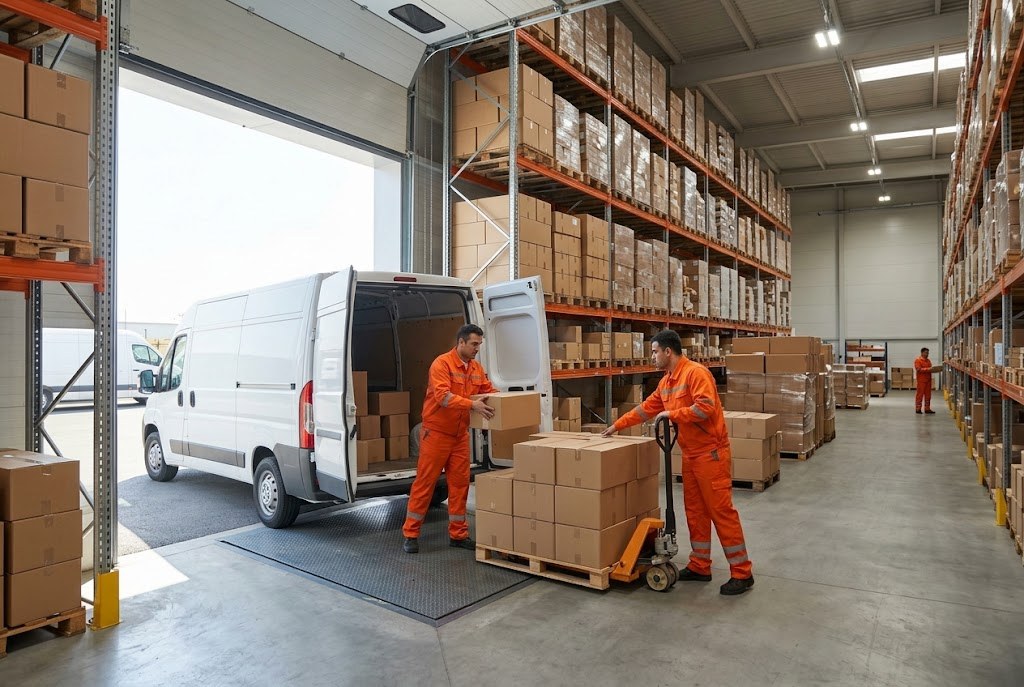
Warehouse and distribution transport: distribution from the warehouse to points of sale, transfers between warehouses and supply of store chains. The route is built in advance and the cargo is handed over with a count at every address.
- Several points of sale in one trip
- The route is planned in advance
- Handover with a count at every address
- Weekly and daily schedule
Free insurance
Every order is insured
Fixed price
The amount quoted on the call does not change
24/7 orders
Nights, weekends, holidays
Materials provided by us
Stretch film, cardboard, straps
Work included in the price
Building the route
Addresses are ordered by distance, reducing lost time.
Separating the cargo
The cargo for each address is stacked and labelled separately.
Handover with a count
At every point the cargo is handed over with a count.
Transfers between warehouses
Full or partial transfer from warehouse to warehouse.
Loading team
Unloading at each address is done by the team.
Regular schedule
Weekly or daily trips are set up.
From order to handover — 4 steps
Call or form
The number of addresses, cargo volume and schedule are confirmed.
Route and price
The route is built, and the amount and departure times are given.
Loading at the warehouse
The cargo for each address is separated and loaded into the vehicle.
Distribution
Handed over with a count at each point.
What affects the price
No made-up rates: the amount is calculated on the call based on these factors and does not change when the move is finished.
- Number of addresses
- Total cargo volume
- Length of the route
- Regularity of trips
- Number of movers
How the route is built in distribution transport
In warehouse and distribution transport the main cost is not fuel — it’s time. When addresses are ordered incorrectly, the vehicle passes through the same area twice, unloading is delayed and the points planned for the day aren’t reached.
Yük.az builds the route before the trip starts: addresses are ordered by distance and opening hours. The cargo for each address is stacked and labelled separately at the warehouse so nothing has to be searched for during unloading.
At every point the cargo is handed over with a count — this prevents mismatches between the store and the warehouse. Transfers between warehouses are done the same way, in full or in part.
A weekly or daily schedule can be set up for store chains — this is more affordable than placing a separate order each time.
In distribution transport the main cost is not fuel but time. When addresses are ordered incorrectly, the vehicle passes through the same area twice, unloading is delayed and some of the points planned for the day are left out. That is why the route is built before the trip.
When building the route, not only distance but also the points’ working hours are taken into account. A store that opens early goes first, a warehouse that receives at midday goes later. This ordering gains one or two extra addresses during the day.
Number of points and preparation in distribution transport
Separating the cargo at the warehouse speeds up unloading. Each address’s goods are stacked and labelled separately so the driver doesn’t have to search when he reaches the point. In large chains this means saving 10–15 minutes at each stop.
Transfers between warehouses follow the same logic: the cargo is grouped, counted and moved in stages. A full transfer is completed in several trips, a partial one in a single trip.
The number of points directly determines the length of the trip. A five-address route and a fifteen-address route can’t be completed with the same vehicle on the same day. That is why, when planning, not only the distance but also the time spent at each stop is calculated.
Preparation at the warehouse must be finished before the trip. If the cargo isn’t ready, the vehicle waits at loading and the whole route shifts. A shipment that is already stacked and labelled cuts loading down to a few minutes.
Official rules on customs warehouses and goods turnover are published on the website of the State Customs Committee.
Most asked questions about this service
The number of addresses depends on the cargo volume and the length of the route — we plan it together when you order.
Yes. Full or partial transfers from warehouse to warehouse are carried out.
Yes. The cargo is handed over with a count at every address.
Yes. We set up weekly and daily trips — there is no need to place an order each time.
Yes. Routes are also built to points of sale in the regions.
You give us the addresses, and we build the route based on distance and working hours. If you prefer, we can keep your own order.
The cargo is handed over with a count at every address and the recipient confirms. For corporate customers, document flow is formalised.
On a regular schedule the same driver is assigned — since he already knows the addresses and receiving rules, the trip goes faster.
It depends on how close the addresses are to each other and on receiving hours. When the route is built, you are told in advance how many points can realistically be covered.
