 Skip to the content

Heavy machinery transport on flatbeds across Azerbaijan
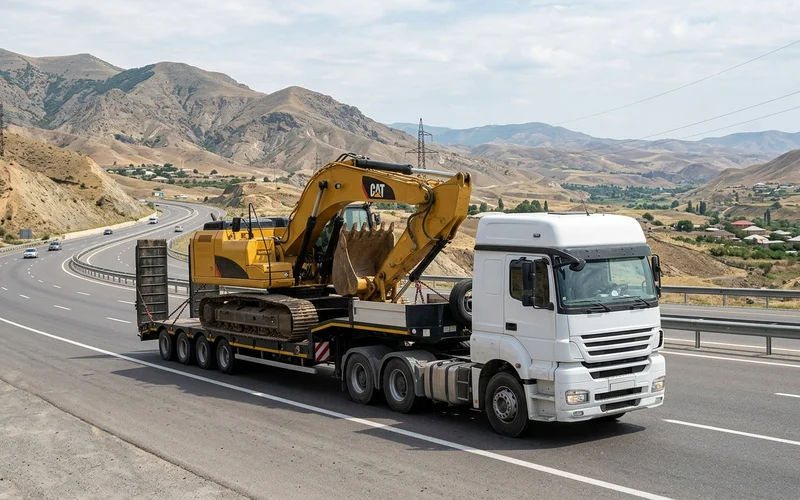
Heavy machinery transport on flatbeds and specialized lowboy trailers represents one of the most demanding segments of heavy-haul industrial logistics. Moving oversized excavators, bulldozers, crawler cranes, and agricultural combines cannot be performed with conventional box or curtainside trailers. Such machinery possesses massive operating weights, high centers of gravity, and non-standard dimensions that require open-deck trailers, removable gooseneck platforms, and multi-axle heavy haulers. As extensive infrastructure expansion continues across Azerbaijan, particularly throughout the Baku industrial zones and the revitalized regions of Karabakh and East Zangezur, timely equipment deployment is vital to keeping projects on schedule. In this complex operational environment, the dedicated digital freight network Yuk.az provides reliable connectivity between project contractors and certified heavy-haul carriers. In accordance with global standards documented in heavy semi-trailer technologies, engineering precision and rigorous load securement are non-negotiable prerequisites for road safety.
Trailer types: Lowboys, step decks, and heavy flatbed configurations
In modern industrial and civil engineering projects, heavy machinery transport on flatbeds ensures that critical machinery reaches work sites without disruption. Selecting the appropriate deck geometry is crucial to maintaining low overhead clearances while complying with national bridge weight limits.
Lowboy (RGN) and low-bed trailers for tall machinery
Lowboy trailers, especially removable gooseneck (RGN) designs, are specifically engineered to accommodate tall construction machinery. Featuring a well deck positioned merely 0.5 to 0.8 meters above the tarmac, lowboy trailers enable machinery exceeding 3.2 meters in height to clear overhead utility lines, bridges, and toll structures. The detachable neck mechanism allows tracked vehicles to be driven directly onto the trailer bed from ground level, eliminating the steep angles and tipping risks associated with traditional rear ramps.
Extendable multi-axle platforms for long and heavy equipment
When transporting extended drill rigs, telescopic crane booms, or prefabricated structural assemblies, extendable trombone trailers provide indispensable versatility. These heavy platforms can stretch from standard lengths of 13.6 meters up to 25 or 30 meters. Supported by four to eight steerable axles, these trailers distribute payloads of 40 to 80 tons uniformly across the road surface to prevent pavement fatigue.
Heavy machinery transport on flatbeds: tie-down standards and load security
Regional infrastructure operations rely heavily on heavy machinery transport on flatbeds to shift massive earthmoving machinery across diverse terrains. Preventing load shifting during abrupt acceleration, braking, or sharp turns requires strict compliance with international cargo securement regulations.
Heavy-duty chains, ratchet binders, and angle calculations
Securing high-tonnage machinery demands Grade 70 or Grade 80 transport chains paired with heavy-duty ratchet load binders instead of synthetic webbing straps. Each piece of heavy machinery must be anchored from at least four independent corners using crossed chains pulled to calculated tension angles. Furthermore, movable attachments such as excavator booms, buckets, counterweights, and dozer blades must be lowered to the deck and independently pinned and chained.
Center of gravity management and axle load dispersion
Proper weight distribution is essential because heavy machinery transport on flatbeds involves substantial axle weights across bridge networks. Position calculations account for asymmetric weight profiles, aligning the machine center of mass directly over the trailer tridem or tandem axle group. Correct placement prevents excessive fifth-wheel loading on the tractor unit, safeguarding steering traction and braking equilibrium.
Machinery categories: Excavators, bulldozers, cranes, and agricultural units
Industrial development in major manufacturing corridors requires customized logistical solutions for diverse machinery types. Each machine category features unique physical dimensions, ground clearances, and surface contact dynamics.
Earthmoving, tracked, and wheeled construction machinery
Tracked excavators ranging from 20 to 50 tons, track-type tractors (bulldozers), wheel loaders, and vibratory soil compactors represent standard heavy-haul freight. For machinery exceeding the standard legal width of 2.55 meters, heavy-duty trailers utilize fold-out side outriggers surfaced with dense hardwood planks to provide full, stable track support.
Agricultural equipment: Tractors, harvesters, and implements
Seasonal agricultural operations in the Mugan, Shirvan, and Ganja-Gazakh regions require regular transport of combine harvesters, cotton pickers, and large four-wheel-drive tractors. To maintain safe transport dimensions, wide cutting heads (headers) are detached and carried on specialized trailing headers, while oversized tractor tires are secured with steel wheel chocks and tensioned wheel nets.
Modular transformers, turbines, and drilling rigs
Power transmission stations and energy installations frequently require heavy components that exhibit concentrated mass footprints. Multi-axle hydraulic modular trailers are deployed for these applications, allowing operators to level the bed dynamically and negotiate rough unpaved access paths safely.
Routing and oversized haul permits across Azerbaijan
Oversized and overweight transport operations across Azerbaijan are governed by strict road administration protocols. Logistics engineers perform route surveys prior to haulage to evaluate vertical bridge clearances, roundabout radii, and load capacities.
Transit corridors (M1, M2, M3, M4) and clearance verification
Primary transit routes including Baku-Guba-Russia (M1), Baku-Ganja-Georgia (M2), Alat-Astara-Iran (M3), and Baku-Shamakhi (M4) serve as key arteries for heavy industrial machinery. Transporters secure oversize permits through the Azerbaijan Land Transport Agency (AYNA) and the Main State Traffic Police (DYP). When dimensions exceed statutory thresholds, dedicated escort pilot vehicles equipped with amber warning beacons accompany the convoy.
Rebuilding projects in Karabakh, East Zangezur, and industrial hubs
Infrastructure construction in Fuzuli, Aghdam, Shusha, Kalbajar, and Lachin presents complex terrain challenges including steep mountain grades and serpentine roads. Heavy 6×4 and 6×6 prime movers equipped with engine retarders and hydraulic brake systems ensure safe descent and reliable power delivery during demanding mountain climbs.
Frequently Asked Questions
What permits are required for moving oversized heavy equipment?
Whenever the gross vehicle combination exceeds 2.55 meters in width, 4.0 meters in total height, 20 meters in length, or 40 metric tons in gross vehicle weight, special permits must be issued by the Azerbaijan Land Transport Agency (AYNA) in coordination with the State Traffic Police.
How is heavy tracked equipment safely loaded onto flatbed trailers?
Loading is carried out by experienced equipment operators using heavy-duty hydraulic or mechanical ramps, or via front-loading detachable gooseneck platforms that offer an ultra-low approach angle to eliminate rollover risks.
How are transport costs calculated for heavy industrial machinery?
Haulage costs depend on machinery dimensions, gross weight, point-to-point transit distance, road conditions, escort vehicle requirements, and special permit fees. Because every oversized journey is customized, standardized fixed rates do not apply.
When are pilot escort vehicles mandated during flatbed haulage?
Escort pilot vehicles with amber strobe lights are legally required when the loaded transport width exceeds 3.5 meters or overall convoy length exceeds 24 meters, alerting surrounding motorists to the oversize load.
Partnering with experienced carriers ensures that heavy machinery transport on flatbeds remains compliant, timely, and cost-effective for any demanding project. Choosing verified transport solutions guarantees maximum safety and seamless equipment mobilization for your construction and industrial goals.
Related service: Special cargo transport — to get a price, call 050 209 62 99.

Related posts

What to agree with a moving company before booking
A moving company and its customer should have the same understanding of the job.
Cargo transportation in Samukh: farm and household moves
Cargo transportation in Samukh is an essential logistics service supporting agri

Grain tipper truck transportation: efficiency and fleet guide
Grain tipper truck transportation is a vital pillar of modern agricultural logis


Leave a Reply