

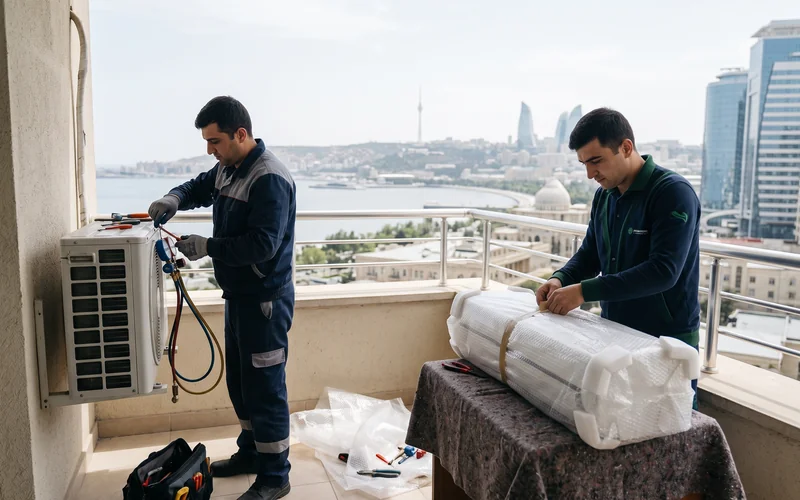
Air conditioner moving and relocation: safe freon pumping guide
Air conditioner moving and relocation is a specialized technical procedure that involves much more than simply detaching an appliance from the wall. Modern split systems consist of an indoor evaporator unit and a heavy outdoor condenser unit connected by a pressurized closed-loop refrigerant circuit. Improper dismantling can cause severe environmental damage through gas leaks, ruin internal motor components by spilling compressor oil, or bend fragile heat exchanger fins. Proper air conditioner moving and relocation guarantees that your cooling system operates at maximum efficiency without expensive refrigerant top-ups. Understanding the necessary safety precautions, specialized rigging tools, and packing methods ensures a smooth transition to your new home.
Air conditioner moving and relocation: essential preparation steps
Before touching any mechanical or electrical fasteners, comprehensive diagnostic testing is essential. The split system should be switched on in standard cooling mode to verify that the thermostat responds accurately, the blower wheel spins without noise, and the compressor runs smoothly without abnormal vibration. Documenting the pre-move working state prevents confusion regarding preexisting technical issues once the equipment arrives at the destination.
Electrical disconnection and diagnostic checks
Electrical safety is the paramount priority during climate control system disassembly. The unit must be entirely disconnected from the main electrical supply by turning off the dedicated circuit breaker in the panel. Before detaching the interconnecting wires between the indoor and outdoor units, each terminal connection should be clearly labeled with colored electrical tape or waterproof markers. Proper labeling prevents wire cross-connections and protects sensitive circuit boards from short circuits during reassembly.
Required tools and technical equipment
Successfully dismounting an air conditioning unit without damaging flare connections or losing refrigerant requires specialized equipment:
- Hex keys (Allen wrenches) designed to operate service port valves;
- Refrigerant manifold gauge set with pressure hoses;
- Specialized tubing cutter and copper pipe flaring tool;
- Brass cap nuts, electrical insulation tape, and sealing plugs;
- Impact driver, level ruler, screwdrivers, and a sturdy step ladder.
Refrigerant recovery and sealing copper pipes
The most critical technological stage during relocation is pumping down the refrigerant back into the outdoor compressor unit. Unskilled movers frequently cut the copper pipes directly, discharging expensive fluorocarbon gas into the atmosphere. This illegal practice not only damages the environment but also forces the homeowner to spend an extra 60 to 120 AZN on complete system recharging at the new property.
Pumping freon back into the outdoor compressor unit
To preserve the refrigerant, the air conditioner is turned on in forced cooling mode. Protective caps from the service valves on the outdoor unit are removed, and a manifold gauge is connected to the low-pressure service port. With the compressor actively running, the technician uses a hex wrench to tightly close the small liquid line valve (high-pressure port). Over the next 30 to 50 seconds, the compressor pumps all refrigerant from the indoor unit and lines into the outdoor condenser coil. Once the gauge reaches zero, the large suction valve (low-pressure port) is swiftly closed, and the electrical power is immediately cut. The entire refrigerant volume is now safely locked inside the condenser.
Sealing copper lines and labeling electrical wiring
Once the refrigerant circuit is sealed, the copper flare connections can be loosened. Both the open service ports on the condenser and the ends of the copper tubing must be hermetically sealed with sealing caps or heavy-duty vinyl tape immediately. Introducing even minute amounts of atmospheric moisture, airborne dust, or construction debris into the copper circuit will cause acid buildup, valve clogging, and premature compressor burnout.
Protective packing methods for split system components
A professional air conditioner moving and relocation safeguards delicate condenser fins, electronics, and structural mounting hardware. Components of modern air conditioning systems feature thin aluminum heat transfer fins and glossy acrylic panels that require multi-layer cushioning.
Shielding delicate condenser fins and housing panels
The aluminum heat exchanger fins situated on the rear and side of the outdoor unit are extraordinarily thin and can bend under slight pressure. Bent fins obstruct airflow, resulting in severe compressor overheating and reduced cooling capacity. To protect these fins during handling, cut a rigid sheet of 5-ply corrugated cardboard to fit over the coil face, then wrap the entire outdoor unit in three layers of heavy-duty bubble wrap and secure with industrial stretch film.
Organizing mounting brackets, remotes, and hardware
The indoor evaporator unit must be unhooked from its metal wall mounting plate, which is then unscrewed from the wall. Losing this specific mounting bracket makes reinstallation extremely complicated and costly. Place the remote control, wall cradle, drainage pipe fittings, and mounting screws into a labeled transparent zip pouch and tape it firmly to the rear side of the wrapped indoor unit.
Multi-layer wrapping with bubble wrap and cardboard
The indoor unit’s exterior shell is vulnerable to surface scuffs and broken louvers. Wrap the indoor unit in soft protective foam or clean furniture blankets, followed by heavy bubble wrap. Pack the wrapped unit into a tailored cardboard box, filling any empty spaces with packing paper or foam peanuts to prevent shifting during transit.
Vehicle transport rules and strict vertical alignment
Transporting climate control machinery inside a moving truck requires strict adherence to spatial orientation rules. Loading heavy condensing units haphazardly onto their sides is among the most catastrophic moving errors.
Why compressor units must always be transported upright
Outdoor condenser units must ALWAYS be transported in a STRICTLY VERTICAL (upright) position. The hermetically sealed compressor contains specialized refrigeration lubricant oil. Laying the unit horizontally allows this oil to migrate into the condenser coils and suction line. If the unit is energized before the oil drains back, the compressor experiences oil starvation and seizes mechanically. Inside the truck cargo bed, place the unit on a non-slip rubber mat and secure it against the side rails using heavy-duty ratchet straps.
Staircase handling and freight elevator logistics in Baku
When organizing air conditioner moving and relocation across multi-story buildings in Baku, heavy lifting protocols and freight elevator rules must be respected. While newly built residential towers usually feature spacious cargo elevators, older Soviet-era buildings require manual descent via narrow staircases. Outdoor units weighing between 30 and 60 kg must be carried using specialized shoulder rigging straps to distribute weight evenly and prevent collisions with stair railings.
Reinstallation, vacuuming, and moving cost factors
Mounting the climate system at your new home requires millimeter precision. The indoor bracket must be installed dead level to ensure condensation drains smoothly, and the outdoor brackets must feature vibration-dampening rubber bushings.
Vacuum pump degassing before releasing the refrigerant
After joining all copper flare nuts, degassing the lines with a professional two-stage vacuum pump is an indispensable requirement. Operating the vacuum pump for 15 to 20 minutes extracts ambient air, non-condensable gases, and moisture droplets from the copper loop. Only after establishing a stable vacuum are the service valves cracked open to release the preserved refrigerant into circulation. For guaranteed technical safety and seamless execution, you can always count on verified technicians and logistics support through Yuk.az.
Key factors that determine relocation expenses
Transparent pricing for moving air conditioning units depends on several distinct factors:
- Cooling capacity and system weight (ranging from 9,000 BTU bedroom units to 24,000 BTU living room split systems);
- Building floor level and availability of functioning cargo elevators;
- Exterior facade complexity (whether installation requires industrial abseiling or hydraulic boom lifts);
- Total length of new copper tubing, insulation sleeves, and drainage hoses required;
- Travel distance between premises and porter crew requirements.
Frequently Asked Questions
How can freon be preserved during split system dismantling?
Freon is safely preserved by running the system in cooling mode, closing the thin high-pressure liquid valve with an Allen wrench, waiting until the pressure drops to zero on the manifold gauge, closing the thick suction valve, and immediately turning off power.
Can the outdoor condenser unit be transported horizontally?
No, outdoor compressor units should never be transported horizontally. Laying the unit on its side causes internal compressor oil to flood the cooling coils, risking complete mechanical seizure when the unit is powered on at the new location.
Is it possible to reuse the existing copper pipe lines?
Existing copper pipes can be reused if they have not been kinked, cracked, or contaminated during removal, and if their length is sufficient for the new layout. Otherwise, installing fresh refrigeration lines is strongly advised.
What determines the total air conditioner moving and relocation price?
The price is determined by the unit’s BTU capacity and weight, dismantling complexity, building floor levels, elevator availability, additional copper piping needs, and the travel distance between addresses.
Relocating split-system air conditioning units requires technical precision, specialized refrigeration tools, and experienced logistics care. By following professional refrigerant recovery protocols, ensuring vertical transport, and vacuuming lines prior to restart, you guarantee peak cooling performance and comfort in your new home.
Related service: Special cargo transport — to get a price, call 050 209 62 99.

Related posts

TIR cargo transportation in Gakh: agro logistics and freight
Located at the foot of the Greater Caucasus mountain range, professional TIR car

Oversized Cargo Transportation in Azerbaijan | Yuk.az
The rapid growth of construction, industrial, and agricultural sectors across Az

TIR cargo transportation in Ordubad: fruit export & logistics
For commercial orchards and regional manufacturing enterprises, professional TIR

Leave a Reply